No products in the cart.
Refrigerant Leak Detection Methods Compared
Every retrofit, every recharge and most callbacks come down to the same question: where is it leaking? Choosing the wrong detection method wastes an hour and sometimes sends you home without an answer.
Soap bubbles
Cheap, reliable within its range, and still the right answer for a suspected joint you can see and reach. Its limit is sensitivity — bubble solution finds leaks around 0.5 oz/yr at best, which misses the slow losses that empty a system over a season.
Use it to confirm a leak you have already located. Do not use it to search.
UV dye
Good for intermittent and hard-to-reach leaks, because it leaves a permanent mark you can find on a return visit. The trade-offs are real: it takes time to circulate, some manufacturers void warranty over dye use, and it adds a contaminant to the system.
Best for leaks that only appear under vibration or load, where a sniffer test on a static system finds nothing.
Heated diode and corona discharge sniffers
The traditional electronic detectors. Sensitive enough for most work and inexpensive, but they share a weakness: sensors degrade with use, and they false-trigger on oil, moisture and cleaning chemicals. In a dirty mechanical room they will chirp at things that are not refrigerant, and the sensor needs periodic replacement whether or not it has found anything.
Infrared sensors
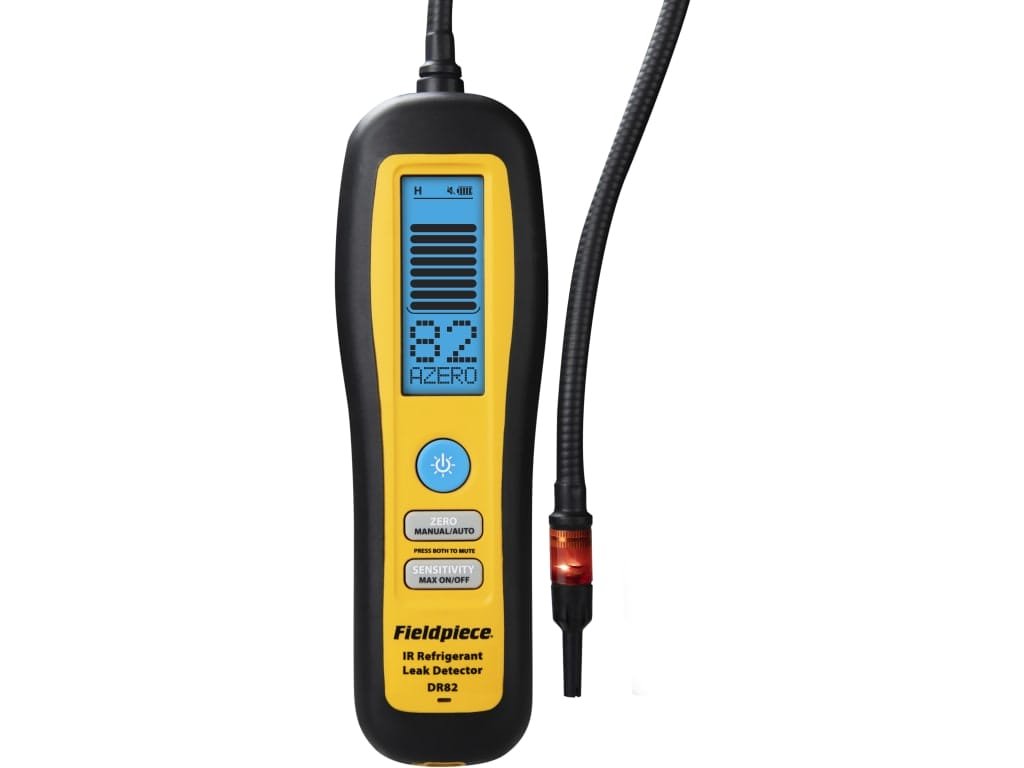
Infrared detection identifies refrigerant by how it absorbs specific wavelengths, so it does not respond to oil or moisture and does not drift as it ages. Sensitivity reaches around 0.03 oz/yr — roughly twenty times what bubbles will find — and the sensor life is measured in years rather than months.
The Fieldpiece DR82 and the INFICON D-TEK 3 both work this way. Both detect CFC, HCFC, HFC and HFO refrigerants including blends, which matters now that a service van carries five different products.
For A2L refrigerants specifically, check the detector is rated for them — see what A2L changes for technicians.
Thermal imaging
A thermal camera does not detect refrigerant. What it does is show you temperature patterns — a cold spot where liquid is flashing early, an evaporator section not feeding, a blocked line. That narrows the search area before you bring out a sniffer.
A compact unit like the FLIR C5 also covers building diagnostics — insulation gaps, duct losses, electrical hot spots — which is often what justifies it on the van.
A practical sequence
- Check pressures and superheat first — confirm you are actually short of charge
- Thermal scan to narrow the area if the system is large
- Infrared sniffer to locate
- Bubbles to confirm the exact joint before you cut into anything
- UV dye only when the leak is intermittent and you expect a return visit
Browse detection and recovery equipment in HVAC Tools.
Products covered in this guide
Virgin, factory-sealed cylinders. Free shipping across the US.